
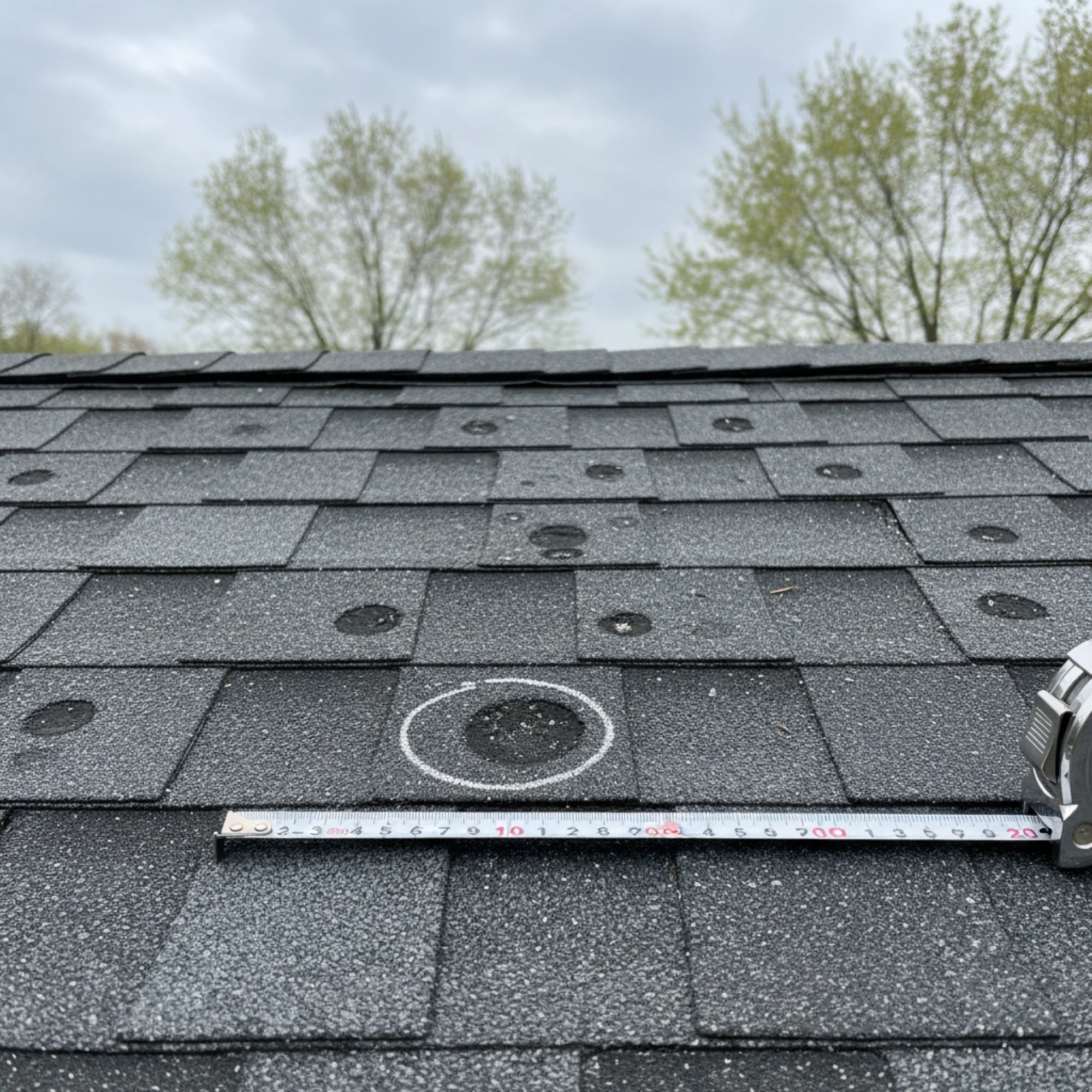
After a hailstorm in Baltimore County or Palm Beach County, two clocks start running. The first is your carrier's notice-of-loss window. Most policies require prompt notice, and Florida statute caps the filing window at one year from the date of loss (Fla. Stat. § 627.70132). The second is the weather itself: rain that follows hail accelerates leaks, and shingle granules continue to wash off long after the impact event. The faster you can produce ground-level documentation, the easier your inspection and claim get. Below is the exact 5-minute walkaround we recommend, the same one our roofers do during a free inspection, so the photos on your phone match what an adjuster expects to see.
The 5-Minute Walkaround
Use your phone camera. No special equipment. Note the time-stamp on each photo. Adjusters use the EXIF date to confirm photos are recent. The order below moves from the easiest evidence to the strongest.
Photograph soft metal first (1 minute).
Walk to your air-conditioner condenser, gas grill, mailbox, downspouts, gutter aprons, and any aluminum patio furniture. Look for round dents, pea-sized to quarter-sized. Take a wide photo of each item and a tight close-up. Soft metal is the single most persuasive piece of evidence in a hail claim because it cannot be faked, weather-aged, or confused with old wear. If your AC fins are dented and the gutters are dimpled, the adjuster has already mentally approved the roof inspection before he gets there.
Photograph your gutter line and downspouts (45 seconds).
Stand at each corner of the house and shoot up the gutter and the trim. You're looking for granule wash piles where the downspout exits onto a splash block. These look like small piles of black-and-gray sand. Granules are the protective surface of an asphalt shingle; when hail fractures the mat, the granules release and travel down the gutter to the downspout. Heavy granule loss at a downspout is a textbook hail signature.
Photograph the underside of the gutter and any window screens (30 seconds).
Bent gutter aprons and torn window screens both indicate hail momentum. Adjusters cross-reference these against the official storm report from the National Weather Service to confirm the size of stones that fell on your specific property.
Document the storm itself (1 minute).
Open your phone weather app, scroll back to the date of the storm, and screenshot the radar and the wind/precipitation summary. Then go to www.spc.noaa.gov/climo/reports and search the date. NOAA publishes hail reports with the largest reported stone size by ZIP code. Save both. Your carrier may pull the same report; matching it shows you're filing on a real event, not speculative.
Sketch a quick site map (90 seconds).
On a napkin or in your phone's notes app, draw a rough rectangle of the house and label the slopes (front, back, left, right). Mark which slopes face the direction the storm came from. That side took the most impact. We use this same north-arrow notation on every damage report we write. It saves the adjuster fifteen minutes on site and keeps the claim file clean.
The Chalk Test: A Homeowner's Secret Weapon
If you have a stick of sidewalk chalk, this 30-second test produces a photo that is genuinely persuasive on a claim file. Stand on a deck, balcony, or second-story window where you can see a section of roof slope safely. Lightly rub the side of the chalk across the shingles in a 4-foot square. Granule loss spots show up as dark circles where the chalk did not deposit because the shingle surface is fractured below the granule layer. Photograph the chalked section straight-on. Adjusters and roofing inspectors both read these patterns the same way: dark dots equal impacts, evenly distributed dots equal a wide-area hail event, which calls for a full slope replacement rather than a spot repair. Do not climb to do this. Only chalk what you can reach safely.
What an Inspector Adds to Your File
When we run a free inspection on a Maryland or Florida home after a hail event, we add four things to what you already have: (1) a marked-up slope diagram with chalk circles around every confirmed impact, (2) close-up photos with a coin or tape measure for scale, (3) shingle uplift checks at every ridge and rake to confirm the wind component of the same storm, and (4) a written repair scope priced to the latest Xactimate database. We provide that scope to you. You are the policyholder; the conversation with your carrier remains your conversation. We can answer roofing-technical questions during the adjuster's site visit if you'd like a contractor present, but the claim itself stays in your name. That separation is required by law. Only licensed public adjusters or attorneys can negotiate a claim on a homeowner's behalf, and we are neither.
Common Documentation Mistakes
Three patterns disqualify hail claims faster than anything else. First, photos without a date. Turn on your camera's date-stamp or rely on EXIF. Second, only top-down photos. Adjusters need scale, so include something for size reference (a quarter, your phone, a tape measure). Third, washing the roof or replacing the AC fins before the adjuster sees them. We've watched homeowners scrub granule wash out of gutters because they thought it was dirt; you just deleted half the evidence. Leave everything as-is until the inspection is complete.
Quick Questions Homeowners Ask After a Hailstorm
- How long do I have to file?
- In Maryland, most carriers require prompt notice and bar claims after one to two years depending on the policy form. In Florida, Fla. Stat. § 627.70132 caps the notice window at one year from date of loss for new claims and 18 months for supplemental claims. Read your policy's Loss Settlement section or call your agent. Earlier is always better for evidence preservation.
- Will filing a claim raise my premium?
- A single weather-event claim (hail, wind) is rated differently from a liability or theft claim by most carriers. Premium impact varies by state, carrier, and your prior loss history. Your independent agent or carrier rep is the right source for that question. We can't predict another company's rating decision.
- Can I do a temporary repair while I wait?
- Yes, and you should if water is entering. Tarp the active leak, document the tarp with photos, and keep receipts. Reasonable mitigation costs are typically reimbursable under most policies. Do not start permanent repairs (re-shingling, full replacements) before the adjuster's site visit. That often invalidates the inspection.
- What if my deductible is higher than the damage?
- Then you have a choice: pay out of pocket for the repair, defer it until you can afford the deductible, or wait for a future event that pushes the claim above your deductible. We will quote any repair without a claim. We do many roof replacements where the homeowner pays cash or finances the project. The decision is yours, and we will not be the ones to tell you to file a claim that does not pencil out.
Storm hit your home? We'll document it.